Know what you can safely spend before your next paycheck.
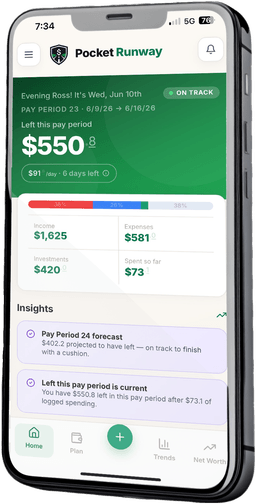
Your bank balance isn't what you can spend. Pocket Runway accounts for upcoming bills, savings and the days until payday, then gives you one clear daily number for what's safe today.
The calculator is free and requires no account. Pocket Runway is $4/month.
Get the app
Soon on the
App Store
GET IT ON
Google Play
Your bank says
$3,842
The balance sitting in checking right now.
Pocket Runway says
$576
safe to spend
$72/day until Friday
How the $576 is reached
- Bills before payday$2,290
- Savings and goals$500
- Already spent$476
- Safe for the next 8 days$576
Bills, savings and upcoming obligations already accounted for.
At a glance
Every Account
In One Pay-Period View
Safe to Spend
Updated as You Spend
Daily Allowance
Through Next Payday
Secure by Design
Private by Default
Why it's different
Why your bank balance isn't what you can spend
A checking balance shows what is in the account right now. It does not show what rent, utilities, savings and the remaining days before payday have already claimed.
A calendar-month budget
$1,178
held back against the whole month, including a phone bill, streaming and savings that are not due until after your next check. A tense, shrunken "left to spend" for money you do not need yet.
Pocket Runway
$900
reserved, because rent is the only thing actually due before payday. The rest is deferred to the paycheck that covers it, so what is left is money you really have this week.
Same balance, same bills. The monthly view holds back $278 that nothing needs yet and calls the rest your spending money. Pocket Runway holds back the $900 that is genuinely due, then tells you how many days the remainder has to stretch.
A monthly budget fights your pay schedule.
Your bank shows the balance. Pocket Runway shows the decision.
How it works
How Pocket Runway calculates what's safe to spend before payday
Pocket Runway starts with the money available now, reserves the obligations due before the next paycheck, protects planned savings and your minimum buffer, then spreads what remains across the actual days left in the pay period. That is the whole idea behind safe to spend before payday.
Available money − upcoming obligations − savings − buffer − spending = safe to spend
Safe to spend ÷ remaining days = daily allowance
Set your pay-period window
Enter your paycheck and cadence: weekly, biweekly, twice a month, monthly or irregular. Pocket Runway tracks the actual window between checks, down to when your paycheck clears.
Reserve only what's due before your next check
Add your bills once. Each pay period, Pocket Runway fences off just the obligations due inside that window, protects your savings plan and your buffer, and defers the rest to the cycle that pays for them.
Spend from what's actually available
What's left is divided by the days until payday. Your bank balance still counts money that's spoken for; this number doesn't, and it updates the moment you log a purchase.
Want to run the numbers first? Use the free daily spending allowance calculator. It runs in your browser and needs no account.
When things change
See what happens when your financial life changes
A useful budget should not break when reality changes. Pocket Runway recalculates the decision, not just the balance.
Unexpected $240 car repair
The expense is covered, but the remaining daily allowance tightens. You see the new number for the rest of the period straight away, instead of finding out on the last Thursday before payday.
A paycheck arrives $400 short
The next runway starts from the money actually received rather than an imaginary average. Essential obligations stay reserved first, and the daily allowance absorbs the difference.
An $85 refund posts
The money returns to the current runway without being treated as a new paycheck. Your pay period keeps its real length, and the refund lifts what is safe to spend inside it.
A three-paycheck month is approaching
The extra check becomes visible before it arrives, giving you time to direct it toward savings, debt or goals rather than letting it disappear into an ordinary month.
Pay schedules
Budget around your paycheck, not the calendar month
Monthly budgets force every household into the same calendar. Pocket Runway plans the actual stretch of time each paycheck needs to cover.
Biweekly pay
Bills fall against the paycheck that actually needs to cover them, including the two months each year with a third check.
Semi-monthly pay
Uneven periods around the 1st, 15th and month-end stay accurate instead of being treated as identical halves.
Weekly pay
Shorter pay cycles stay focused on the obligations and spending that must fit before the next check.
Irregular income
Strong checks create room. Short checks tighten the runway. The plan starts from confirmed money rather than a monthly average that may never arrive.
Features
More than a daily spending calculator
The daily number stays trustworthy because Pocket Runway understands the financial events surrounding it.
Forward pay-period forecasting
See upcoming paychecks, obligations and expected spending without counting future income as money available today.
Runway Reset
Close the previous cycle, confirm the new paycheck, handle what remains and begin the next period with a clean plan.
Goals and sinking funds
Set aside the right amount from each paycheck for savings goals, annual bills, repairs and other irregular expenses.
Variable-income planning
Adjust the runway to the paycheck that actually arrived while protecting essential obligations and tax reserves.
Purchase simulation
See how a purchase changes the safe-to-spend amount and daily allowance before committing to it.
Transactions and reconciliation
Keep spending, refunds, corrections, transfers and account balances reflected in the current runway. Add entries by hand or import a CSV; automatic bank linking is coming soon.
Calendar and trends
Understand what is coming next and how actual spending changes across pay periods.
AI insights and external assistants
Ask questions such as "Can I afford $300 this weekend?" and get an answer grounded in Pocket Runway's financial model, in the app or over a read-only assistant connection.
Who it's for
Built for the way you actually get paid
- Biweekly and semi-monthly employees
- Weekly and hourly workers
- Freelancers and gig workers
- Commission-based earners
- Self-employed and 1099 workers
- Anyone whose bills do not align neatly with a calendar month
If your budget falls apart when a bill lands at the wrong point in the month, the problem may not be discipline. The budget may be using the wrong unit of time.
Pricing
Simple, honest pricing
One complete paycheck-based budgeting system. No ads, no data selling and no feature maze. Cancel anytime.
Pocket Runway
$4 / month
Billed monthly · cancel anytime
- ✓Daily safe-to-spend number and daily allowance
- ✓Pay-period engine for weekly, biweekly, semi-monthly, monthly and irregular pay
- ✓Runway Reset payday closeout
- ✓Bills, transfers and forward pay-period forecasting
- ✓Savings goals, sinking funds and a self-employed tax reserve
- ✓Calendar view and purchase simulation
- ✓Spend Trends analytics over 30 and 90 days
- ✓Transactions, refunds, transfers and CSV import
- ✓Net worth tracking and history
- ✓AI spending insights and a read-only assistant connection
- ✓Unlimited manual accounts
- ✓Automatic bank linking coming soon
FAQ
Common questions, straight answers
What is pay-period budgeting?
Pay-period budgeting plans your money from one paycheck to the next instead of across a calendar month. Each cycle you set aside the bills due before your next check, and what is left is what you can actually spend in that window. It matches the way money really arrives, so the plan does not fall apart mid-month.
How is Pocket Runway different from a monthly budgeting app?
Monthly apps organize bills inside one calendar-month view, even when different paychecks will cover them. Pocket Runway reserves only what is due before your next check, defers the rest to the cycle that pays for it, and turns what is left into one daily spending number.
How does Pocket Runway calculate safe to spend?
It starts with the money you have available now, subtracts the obligations due before your next paycheck, protects your planned savings and your minimum buffer, and subtracts what you have already spent this cycle. What remains is safe to spend, and dividing it by the days left in the pay period gives your daily allowance.
What pay schedules does Pocket Runway support?
Weekly, biweekly, semi-monthly (such as the 1st and the 15th), monthly, and irregular income. You tell it how much and how often you are paid, and every calculation follows the actual window between your checks, including the two months a year when a biweekly schedule pays three times.
How does Pocket Runway handle irregular income?
You confirm each paycheck as it arrives, and the plan adjusts to that check instead of pretending every check is identical. A strong check extends your runway and a short one tightens the daily number. Forecasts for future cycles use a rolling average of your recent spending rather than an income average you may never earn.
What is a Runway Reset?
A Runway Reset is Pocket Runway's payday closeout. When a new pay cycle begins you confirm the paycheck that landed, review what is left over from the last cycle, and decide what to do with it: roll it forward, save it, or put it toward a goal. Every cycle then starts from a clean, deliberate plan.
Does Pocket Runway support sinking funds?
Yes. Sinking funds and savings goals set aside an amount from each pay period toward irregular costs such as annual renewals, car repairs and quarterly tax bills, so they stop arriving as surprises. A contribution counts as money committed, not money spent, so it never burns your daily allowance twice.
Is bank syncing available?
Not yet. Automatic bank linking is built but is not switched on for accounts today, so it is listed as coming soon. Right now you add transactions by hand or import a CSV from your bank, and Pocket Runway matches an imported row against anything you already recorded instead of duplicating it.
How much does Pocket Runway cost?
Pocket Runway is $4 per month, billed monthly, and you can cancel any time. That covers everything: the daily safe-to-spend number, the full pay-period engine, forecasting, spending trends, sinking funds, the what-if simulator and AI insights. No ads and no selling of financial data.
Is there a free trial?
There is no free trial right now. Pocket Runway is $4 per month from the start, and you can cancel from the billing page whenever you want. The daily spending allowance calculator on this site is free and needs no account, so you can see how the math works before you sign up.
More questions? Visit the full Support & FAQ page.
Guides
Guides for every kind of paycheck
However your money arrives, the plan follows your pay cycle. Start with the question you have, or the guide that matches your schedule.
You don't need a budget. You need a Runway.
Stop wondering whether the money in your account is already spoken for. See what is safe today, what is coming next and how long your money needs to last.
Privacy first. No ads and no selling financial data.